
-
- No matching results found.
- Watch history
Recognizing Spiritual Disconnection
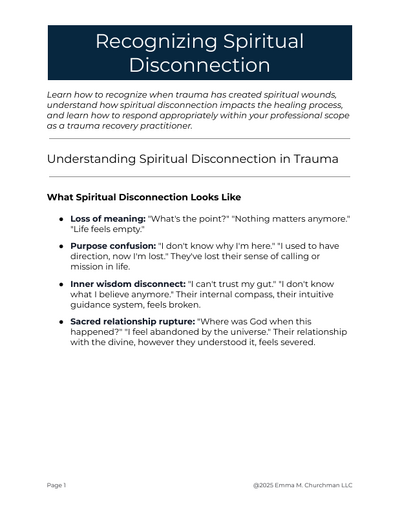
Recognizing Spiritual Disconnection
Learn how to recognize when trauma has created spiritual wounds, understand how spiritual disconnection impacts the healing process, and learn how to respond appropriately within your professional scope as a trauma recovery practitioner.
Understanding Spiritual Disconnection in Trauma
What Spiritual Disconnection Looks Like
- Loss of meaning: "What's the point?" "Nothing matters anymore." "Life feels empty."
- Purpose confusion: "I don't know why I'm here." "I used to have direction, now I'm lost." They've lost their sense of calling or mission in life.
- Inner wisdom disconnect: "I can't trust my gut." "I don't know what I believe anymore." Their internal compass, their intuitive guidance system, feels broken.
- Sacred relationship rupture: "Where was God when this happened?" "I feel abandoned by the universe." Their relationship with the divine, however they understood it, feels severed.
Page 1 @2025 Emma M. Churchman LLC
Recognizing Spiritual Disconnection
The Spiritual Symptoms of Trauma
Here are the specific spiritual symptoms you'll encounter:
- Existential emptiness: They're going through the motions of life without feeling truly alive. It's different from depression - it's a soul-level emptiness.
- Faith crisis: They're questioning previously held beliefs and spiritual practices. Maybe they were devout before, but now they can't access their faith.
- Isolation from the sacred: They're unable to access prayer, meditation, or spiritual connection. The practices that used to nourish them feel empty or impossible.
- Meaning-making paralysis: They cannot find purpose or lesson in their experience. They're stuck in "Why did this happen?" without being able to move to "How can this serve my growth?”
How Spiritual Disconnection Differs from Depression
It's crucial to understand the difference:
- Depression says: "I feel hopeless about everything." It's a general emotional flatness.
- Spiritual disconnection says: "I feel disconnected from something greater than myself." It's specifically about the spiritual dimension.
- Depression is often chemical and emotional flatness: they can't feel joy, sadness, or much of anything.
- Spiritual disconnection is soul-level emptiness and searching: they may feel emotions, but they've lost their sense of connection to meaning, purpose, and the sacred.
Page 2 @2025 Emma M. Churchman LLC
Recognizing Spiritual Disconnection
The Intersection of Trauma and Spiritual Wounding
Here's how trauma creates spiritual wounds:
- Trauma can shatter spiritual worldview and sense of divine protection. If they believed God protected good people, and then trauma happened to them, their entire spiritual framework collapses.
- Betrayal by trusted spiritual figures compounds spiritual disconnection. If the trauma involved clergy, spiritual teachers, or happened in spiritual settings, the wound is even deeper.
- Loss of innocence affects the ability to trust in goodness or higher purpose. Trauma can destroy their fundamental belief that life is good and meaningful.
- Survival mode disconnects from spiritual practices and beliefs. When you're just trying to survive, spiritual connection often feels like a luxury you can't afford.
Page 3 @2025 Emma M. Churchman LLC
Recognizing Spiritual Disconnection
Recognizing Spiritual Disconnection Indicators
Language Patterns That Signal Spiritual Disconnection
- Existential questions: "What's the point of anything?" "Why do bad things happen to good people?" They're wrestling with fundamental questions about life's meaning.
- Meaning-seeking language: "I'm trying to understand why this happened to me." "There has to be a reason for this." They're desperately searching for meaning but can't find it.
- Spiritual abandonment: "God wasn't there for me when I needed Him/Her most." "The Universe doesn't care about me." They feel abandoned by whatever they understood as the divine.
- Purpose confusion: "I don't know what I'm supposed to do with my life now." "I used to know my purpose, but now I'm completely lost.”
Behavioral Indicators of Spiritual Disconnection
Watch for these behavioral changes:
- Abandonment of spiritual practices: They stopped praying, meditating, and attending religious services. Practices that used to be central to their life have been abandoned.
- Existential searching: They're reading spiritual books, seeking gurus, trying different spiritual practices. They're desperately searching for connection they can't find.
- Spiritual numbing: "I don't feel anything when I try to pray." "Meditation used to bring me peace, now it's just empty." They can't access the spiritual states they used to experience.
- Sacred avoidance: They cannot enter churches, temples, or spiritual spaces. These places feel triggering or empty rather than sacred.
Page 4 @2025 Emma M. Churchman LLC
Recognizing Spiritual Disconnection
Energy and Presence Indicators
You'll also notice these energy and presence shifts:
- Soul-level flatness: They're present physically but spiritually absent. There's a quality of spiritual emptiness in their presence.
- Searching energy: There's a restless seeking for something they can't name. They have spiritual hunger but can't identify what they're hungry for.
- Spiritual hunger: Deep longing for connection they can't access. They want to connect spiritually but don't know how.
- Sacred wound: There's a palpable sense of spiritual injury or betrayal. You can feel the wound in their spiritual dimension.
Using Your Trauma Recovery Tools for Assessment
Your trauma recovery tools can help assess spiritual disconnection:
- Morning Mental Weather Report: Ask, "How is your spiritual weather today?" Include the spiritual dimension in their daily check-in.
- Energy Management Grid: The spiritual quadrant will be consistently depleted. They might score 7s and 8s in other areas, but 2s and 3s spiritually.
- Intuitive Response Protocol: Your spiritual sensitivity picks up their disconnection. You can feel the spiritual emptiness or wound.
- Quick Self-Assessment: Include spiritual well-being indicators. "How connected do you feel to something greater than yourself today?"
Page 5 @2025 Emma M. Churchman LLC
Recognizing Spiritual Disconnection
Impact of Spiritual Disconnection on Trauma Recovery
How Spiritual Disconnection Slows Healing
Spiritual disconnection significantly impacts the healing process:
- Meaning-making difficulties: They cannot find purpose in their suffering. Without spiritual connection, they can't move from "Why did this happen TO me?" to "How is this happening FOR me?”
- Hope depletion: Without spiritual connection, hope feels impossible. Hope often requires faith in something greater than our current circumstances.
- Isolation amplification: They're disconnected from spiritual community and support. They've lost not just personal spiritual connection but community spiritual support.
- Identity confusion: "If I'm not who I thought I was spiritually, who am I?" Their spiritual identity was central to their sense of self, and now it's shattered.
Page 6 @2025 Emma M. Churchman LLC
Recognizing Spiritual Disconnection
The 'Why TO Me' vs. 'How FOR Me' Spiritual Dimension
This is where spiritual disconnection really impacts recovery:
- Spiritual victim consciousness: "God abandoned me." "The universe is against me." They feel victimized not just by people but by life itself.
- Spiritual creator consciousness: "How is this experience serving my soul's evolution?" "What is my soul learning through this?" This requires spiritual connection to access.
- Spiritual disconnection keeps clients stuck in victim consciousness. Without spiritual connection, they can't access the perspective that sees trauma as serving their growth.
- Spiritual reconnection enables the shift to creator consciousness. When they reconnect spiritually, they can begin to see their trauma as part of their soul's journey.
Spiritual Disconnection and the Four Phases
Spiritual disconnection affects each phase differently:
- Rescue Phase: Spiritual crisis alongside emotional crisis. They're not just emotionally dysregulated - they're spiritually lost.
- Recovery Phase: Beginning to question spiritual beliefs and practices. They're starting to examine what they believed before and whether it still serves them.
- Reconstruction Phase: Rebuilding spiritual worldview and practices. They're creating new spiritual understanding that can hold their trauma experience.
- Evolution Phase: Integrating trauma into spiritual growth and service. They see their trauma as part of their spiritual journey and calling to serve others.
Page 7 @2025 Emma M. Churchman LLC
Recognizing Spiritual Disconnection
Signs That Spiritual Disconnection Is Impacting Recovery
Here are the signs that spiritual disconnection is slowing their healing:
- Client seems stuck despite mastering trauma recovery tools. They're using all the tools correctly, but they're not progressing. Something deeper is blocked.
- Persistent existential despair even when emotionally regulated. They can regulate their emotions, but they still feel hopeless about life's meaning.
- Inability to find meaning or purpose in their healing journey. They can't see why they're doing the work or what it's leading to.
- Resistance to post-traumatic growth concepts. They can't imagine that their trauma could serve their growth because they can't access spiritual perspective.
Page 8 @2025 Emma M. Churchman LLC
Recognizing Spiritual Disconnection
Appropriate Professional Response to Spiritual Disconnection
Within Your Scope as a Trauma Recovery Practitioner
Here's how to respond appropriately within your scope:
- Recognize and normalize: "Trauma often affects our spiritual connection. This is a normal response to what you've been through.”
- Assess impact: "How is this spiritual disconnection affecting your healing process? Is it making it harder to find hope or meaning?”
- Support exploration: "What did spiritual connection look like for you before this happened? What practices used to nourish you?”
- Integrate with tools: Include the spiritual dimension in your Energy Management Grid. Make spiritual well-being part of your assessment process.
Page 9 @2025 Emma M. Churchman LLC
Recognizing Spiritual Disconnection
Professional Boundaries Around Spiritual Work
Maintain clear professional boundaries:
- You are not their spiritual director or pastor. You don't provide spiritual guidance or interpret spiritual experiences.
- You recognize spiritual disconnection, but you don't provide spiritual counseling. You identify the issue, you don't solve it.
- You support their spiritual exploration, you don't guide their spiritual beliefs. You encourage them to explore, but you don't tell them what to believe.
- You refer to appropriate spiritual professionals when needed. Know when to refer to chaplains, spiritual directors, or clergy.
Language for Addressing Spiritual Disconnection
Use this language when addressing spiritual disconnection:
- “I notice you're struggling with questions of meaning and purpose. That's really common after trauma.”
- “Trauma often affects our spiritual connection - that's a normal part of what you're experiencing.”
- “How important was spiritual connection to you before this experience? What did that look like?”
- “Would exploring spiritual support be helpful as part of your healing process? I can help you find appropriate resources.”
Page 10 @2025 Emma M. Churchman LLC
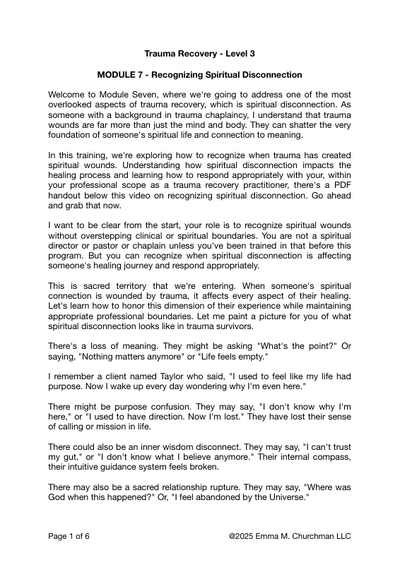
Trauma Recovery - Level 3
MODULE 7 - Recognizing Spiritual Disconnection
Welcome to Module Seven, where we're going to address one of the most overlooked aspects of trauma recovery, which is spiritual disconnection. As someone with a background in trauma chaplaincy, I understand that trauma wounds are far more than just the mind and body. They can shatter the very foundation of someone's spiritual life and connection to meaning.
In this training, we're exploring how to recognize when trauma has created spiritual wounds. Understanding how spiritual disconnection impacts the healing process and learning how to respond appropriately within your professional scope as a trauma recovery practitioner, there's a PDF handout below this video on recognizing spiritual disconnection. Go ahead and grab that now.
I want to be clear from the start, your role is to recognize spiritual wounds without overstepping clinical or spiritual boundaries. You are not a spiritual director or pastor or chaplain unless you've been trained in that before this program. But you can recognize when spiritual disconnection is affecting someone's healing journey and respond appropriately.
This is sacred territory that we're entering. When someone's spiritual connection is wounded by trauma, it affects every aspect of their healing. Let's learn how to honor this dimension of their experience while maintaining appropriate professional boundaries. Let me paint a picture for you of what spiritual disconnection looks like in trauma survivors.
There's a loss of meaning. They might be asking "What's the point?" Or saying, "Nothing matters anymore" or "Life feels empty."
I remember a client named Taylor who said, "I used to feel like my life had purpose. Now I wake up every day wondering why I'm even here."
There might be purpose confusion. They may say, "I don't know why I'm here," or "I used to have direction. Now I'm lost." They have lost their sense of calling or mission in life.
There could also be an inner wisdom disconnect. They may say, "I can't trust my gut," or "I don't know what I believe anymore." Their internal compass, their intuitive guidance system feels broken.
There may also be a sacred relationship rupture. They may say, "Where was God when this happened?" Or, "I feel abandoned by the Universe."
Page 1 of 6 @2025 Emma M. Churchman LLC
Spiritual Disconnection
Their relationship with the divine, however they understood it feels severed. Let me give you some specific spiritual symbols that you'll encounter. There's a sense of existential emptiness. They're going through the motions of life without feeling truly alive.
It's different from depression. It's a soul-level emptiness. They might be having a faith crisis where they're questioning previously held beliefs and spiritual practices. Maybe they were devout before, but now they cannot access their faith.
Third is there may be isolation from the sacred where they're unable to access prayer, meditation, or spiritual connection. The practices that used to nourish them feel empty or impossible.
Finally, there's meaning-making paralysis. They may say they cannot find purpose or a lesson in their experience. They may be stuck in "Why did this happen?" - without being able to move to, "How can this serve my growth?" And it's crucial to understand the difference.
Depression sounds like, "I feel hopeless about everything." It's a general emotional flatness. Spiritual disconnection says "I feel disconnected from, from something greater than myself." It's specifically about the spiritual dimension. Depression is often chemical and emotional flatness where the person cannot feel joy or sadness or much of anything.
Spiritual disconnection is characterized by soul-level emptiness and searching. Individuals may still experience emotions, but they've lost their sense of connection to meaning, purpose, and the sacred.
I had a client who was not depressed. She could laugh, feel joy, engage with life, but she said, "I feel I'm living in a Universe that does not care about me. I can't feel God anymore."
Here is how trauma creates spiritual wounds. Trauma can shatter spiritual worldview and a sense of divine protection. If someone believed God protected good people and then trauma happened to them, their entire spiritual framework collapses. Betrayal by a trusted spiritual figure compounds that sense of spiritual disconnection.
If the trauma involved clergy, spiritual teachers where happened in spiritual settings, the wound is even deeper. Loss of innocence also affects the ability to trust in goodness or higher purpose. Trauma can destroy their fundamental belief that life is good and meaningful.
Page 2 of 6 @2025 Emma M. Churchman LLC
Survival mode also disconnects from spiritual practices and beliefs. When someone is simply trying to survive, spiritual connection often feels like a luxury that they cannot afford.
So listen for these specific language patterns, they may be asking existential questions such as, "What's the point of anything?" Or "Why do bad things happen to good people?" They're wrestling with fundamental questions about life's meaning.
They may use meaning-seeking language, for example, "I'm trying to understand why this happened to me," or "There has to be a reason for this." They're desperately searching for meaning, but they cannot find it.
There may be spiritual abandonment language where they're saying, "God wasn't there for me when I needed him or her the most," or "The Universe doesn't care about me." They may feel abandoned by whatever they understood as the divine.
There's also purpose-confusion language. They may say, "I don't know what I'm supposed to do with my life now," or, "I used to know my purpose, but now I'm completely lost."
There are also behavioral indicators of spiritual disconnection, so watch for these behavioral changes. For example, abandonment of spiritual practices. They have stopped praying, meditating, or attending religious services. Practices that used to be central to their life have been abandoned.
Second is existential searching. They're reading spiritual books. They're seeking gurus. They're trying different spiritual practices. They're desperately searching for connection that they cannot find.
Third is spiritual numbing. They're saying "I don't feel anything when I try to pray," or "Meditation used to bring me peace, but now it's just empty." They cannot access the spiritual states that they used to experience.
And then fourth is sacred avoidance. They cannot enter churches, temples, or spiritual spaces. These places feel triggering or empty rather than sacred. I remember a client who had been sexually abused by a priest. She said, "I can't even drive past a church without feeling sick. And I used to find such a sense of peace there."
There are also energy and presence indicators. For example, soul level flatness, where they are present physically, but spiritually absent. There's a quality of spiritual emptiness in their presence.
Page 3 of 6 @2025 Emma M. Churchman LLC
Second is a searching energy. There's a restlessness seeking for something they cannot name. They have spiritual hunger, but they cannot identify what they're hungry for.
Third is that spiritual hunger. They've got a deep longing for connection that they cannot access. They want to connect spiritually, but they don't know how.
And then fourth is a sacred wound. There's a palpable sense of spiritual injury or betrayal. You can feel the wound in their spiritual dimension.
You can use your trauma recovery tools for assessing a spiritual disconnection. For example, with the Morning Mental Weather Report, you could ask, "How is your spiritual weather today?"
So including the spiritual dimension in their daily check-in, you can utilize the Energy Management Grid. The spiritual quadrant will be consistently depleted. They might score sevens or eights in other areas, but twos or threes spiritually.
Okay. Next is the Intuitive Response Protocol where your spiritual sensitivity picks up their disconnection. You can feel their spiritual emptiness or wound.
And then finally, the Quick Self-Assessment. You can include spiritual wellbeing indicators asking, "How connected do you feel to something greater than yourself today?"
Spiritual disconnection significantly impacts the healing process. For example, with meaning-making difficulties where they cannot find purpose in their suffering without spiritual connection, they cannot move from, "Why did this happen to me?" to "How is this happening for me?"
There's also hope depletion. Without spiritual connection, hope feels impossible. Hope often requires faith in something greater than our current circumstances.
Then there's isolation amplification where they're disconnected from their spiritual community and support they've lost. Not just personal spiritual connection, but community spiritual support.
Then finally, there's identity confusion. They're saying, "If I'm not who I thought I was spiritually, who am I?" Their spiritual identity was central to their sense of self, and now it shattered.
Let's talk about the "Why to me" versus "How for me" spiritual dimension. This is where spiritual disconnection really impacts recovery. Spiritual victim
Spiritual Disconnection and Its Phases
Consciousness says "God abandoned me," or "The Universe is against me." They feel victimized not just by people, but by life itself. Spiritual creator consciousness says, "How is this experience serving my soul's evolution?", or "What is my soul learning through this?"
This requires spiritual connection to access. Spiritual disconnection keeps clients stuck in victim consciousness. Without spiritual connection, they cannot access the perspective that sees trauma as serving their growth. Spiritual reconnection enables them the shift to creator consciousness. When they reconnect spiritually, they can begin to see their trauma as part of their soul's journey.
Let's talk about spiritual disconnection and the four phases, because spiritual disconnection affects each phase differently.
1. Rescue Phase
In the Rescue Phase, spiritual crisis is alongside emotional crisis. They're not just emotionally dysregulated. They're spiritually lost.
2. Recovery Phase
In the Recovery Phase, they're beginning to question their spiritual beliefs and practices. They're starting to examine what they believed before and whether it still serves them.
3. Reconstruction Phase
In the Reconstruction Phase, they're rebuilding their spiritual worldview and practices. They're creating new spiritual understanding that can hold their trauma experience.
4. Evolution Phase
And then finally in the Evolution Phase, they're integrating trauma into their spiritual growth and service. They're seeing their trauma as part of their spiritual journey and their calling to serve others.
Signs of Spiritual Disconnection
Let me give you the signs that spiritual disconnection is slowing their healing.
- The client seems stuck despite mastering trauma recovery tools. They're using all the tools correctly, but they're not progressing. Something deeper is blocked.
- There's persistent existential despair even when they're emotionally regulated. So they can regulate their emotions, but they still feel hopeless about life's meaning.
- Third is an inability to find meaning or purpose in their healing journey. They cannot see why they're doing the work or what it's leading to.
- And then fourth is resistance to post-traumatic growth concepts. They cannot imagine that their trauma could serve their growth because they cannot access that type of spiritual perspective.
Page 5 of 6 @2025 Emma M. Churchman LLC
Responding to Spiritual Disconnection
Let's talk about how to respond appropriately within your professional scope.
So the first is to recognize and normalize, to say, "Trauma often affects your spiritual connection. This is a normal response to what you've been through."
Second is to assess impact, to ask, "How is this spiritual disconnection affecting your healing process? Is it making it harder to find hope or meaning?"
Third is to support their exploration to say, "What did spiritual connection look like before this happened and what practices used to nourish you?"
Okay. And then fourth is to integrate with tools to include the spiritual dimension into your Energy Management Grid to make spiritual wellbeing part of your assessment process.
Maintaining Professional Boundaries
Let's talk about maintaining clear professional boundaries during this. First, unless you've been previously trained, you are not their spiritual director, director or their pastor. You don't provide spiritual guidance or interpret spiritual experiences. You simply recognize spiritual disconnection. You don't provide spiritual counseling. You identify the issue. You don't solve it for them. You support their spiritual exploration, but you don't guide their spiritual beliefs. You encourage them to explore, but you don't tell them what to believe. You refer to appropriate spiritual professionals when needed, so you know when to refer to chaplains, spiritual directors, or clergy.
Language to Use
Let's talk about language to use when addressing spiritual disconnection. For example, you could say, "I notice you're struggling with questions of meaning and purpose. That's very common after trauma." You could say, "Trauma often affects our spiritual connection. That's a normal part of what you're experiencing." You could say, "How important was spiritual connection to you before this experience? And what did that look like?" And finally, you could say, "Would exploring spiritual support be helpful as part of your healing process? I can help you find appropriate resources."
Conclusion
In closing, here's what I want you to remember. Spiritual disconnection is a real and significant trauma symptom that affects the entire healing process. Your recognition and validation of this dimension can be deeply healing for clients who thought no one understood this aspect of their experience.
Appropriate referral honors both your professional scope and their spiritual needs. You're not abandoning them when you refer, you're ensuring they get the specialized spiritual support that they need. When you honor the spiritual dimension of trauma recovery, you're recognizing the full humanity of your clients. You're seeing them not just as minds and bodies that need healing, but as souls that need reconnection to meaning, purpose, and the sacred.
Page 6 of 6 @2025 Emma M. Churchman LLC