
-
- No matching results found.
- Watch history
Supporting Spiritual Breakthroughs
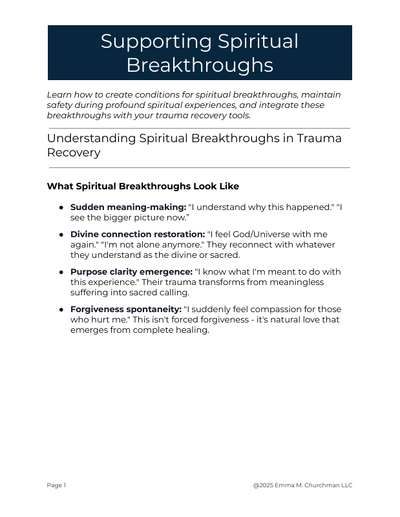
Supporting Spiritual Breakthroughs
Understanding Spiritual Breakthroughs in Trauma Recovery
What Spiritual Breakthroughs Look Like
- Sudden meaning-making: "I understand why this happened." "I see the bigger picture now.”
- Divine connection restoration: "I feel God/Universe with me again." "I'm not alone anymore." They reconnect with whatever they understand as the divine or sacred.
- Purpose clarity emergence: "I know what I'm meant to do with this experience." Their trauma transforms from meaningless suffering into sacred calling.
- Forgiveness spontaneity: "I suddenly feel compassion for those who hurt me." This isn't forced forgiveness - it's natural love that emerges from complete healing.
Page 1 @2025 Emma M. Churchman LLC
Supporting Spiritual Breakthroughs
The Trauma-to-Transcendence Process
Here's the process I've observed countless times:
- Descent into darkness: Trauma creates spiritual crisis and disconnection. They lose faith, meaning, and connection to the sacred.
- Wrestling with meaning: The "Why TO me?" spiritual questioning phase. They're angry at God, questioning everything they believed, feeling spiritually abandoned.
- Breakthrough moment: Sudden shift to "How FOR me?" spiritual understanding. Something clicks, and they see their experience from a completely different perspective.
- Integration and service: Using spiritual insights for healing and helping others. Their breakthrough becomes the foundation for serving others who are still suffering.
Types of Spiritual Breakthroughs
- Meaning-making breakthroughs: Finding sacred purpose in suffering. "This happened so I could become a healer." "My trauma prepared me to help others."
- Connection breakthroughs: Restored relationship with divine/sacred. "I feel God's love again." "I'm connected to something bigger than myself."
- Forgiveness breakthroughs: Spontaneous release of resentment and blame. "I suddenly feel love for my abuser." "I understand they were wounded too."
- Service breakthroughs: Understanding how their healing serves others. "My job is to transform this pain into healing for others." "I'm meant to be a wounded healer.”
Page 2 @2025 Emma M. Churchman LLC
Supporting Spiritual Breakthroughs
The Neurological-Spiritual Connection
Here's something fascinating: spiritual breakthroughs often coincide with neural pathway integration. When the brain creates new pathways for processing trauma, it also creates space for spiritual awareness.
- Spiritual breakthroughs often coincide with neural pathway integration. The same neurological changes that heal trauma also open spiritual awareness.
- The "How FOR me?" shift creates space for spiritual emergence. When they stop being victims of their trauma, they can see it as serving their spiritual evolution.
- Regulated nervous system allows access to spiritual awareness. You can't access spiritual states when you're dysregulated. The trauma recovery tools prepare the ground for spiritual awakening.
- Trauma recovery tools prepare the ground for spiritual awakening. The tools don't cause a spiritual breakthrough, but they create the conditions where it can naturally occur.
Page 3 @2025 Emma M. Churchman LLC
Supporting Spiritual Breakthroughs
Creating Conditions for Spiritual Breakthrough
Environmental and Energetic Preparation
Let's talk about creating the right conditions for spiritual breakthrough:
- Sacred space creation: Honor the spiritual dimension within your clinical setting. This doesn't mean religious symbols - it means creating an atmosphere of reverence and safety.
- Energetic safety: Your regulated presence creates a container for spiritual emergence. When you're grounded and present, clients feel safe enough to open spiritually.
- Timing awareness: Breakthroughs often occur during the Reconstruction-to-Evolution transition. They've done enough healing work to be ready for spiritual emergence.
- Openness without agenda: Create space without forcing spiritual experience. You can't make a spiritual breakthrough happen, but you can create conditions where it's more likely to occur.
Page 4 @2025 Emma M. Churchman LLC
Supporting Spiritual Breakthroughs
Using Trauma Recovery Tools to Facilitate Spiritual Opening
Your trauma recovery tools can facilitate spiritual opening:
- Morning Mental Weather Report: "How is your spiritual weather today?" Include the spiritual dimension in their daily check-in.
- Energy Management Grid: Assess and replenish the spiritual quadrant. When their spiritual energy is depleted, breakthrough is less likely.
- Intuitive Response Protocol: Your spiritual sensitivity guides the session. Trust your intuition about when to go deeper and when to pull back.
- Adaptive Transformation Grid: Track spiritual growth alongside other dimensions. Spiritual breakthrough shows up as growth in the spiritual dimension.
The Role of Suffering in Spiritual Breakthrough
This is crucial to understand: suffering often precedes spiritual breakthrough.
- Honoring the darkness: Don't rush clients out of spiritual crisis. Sometimes they need to wrestle with God, question everything, feel spiritually abandoned. This is part of the process.
- Sacred witnessing: Hold space for spiritual questioning and anger. "I hate God for letting this happen" is often the beginning of spiritual breakthrough, not the end.
- Meaning-making support: "How might this experience be serving your soul's evolution?" Ask the question gently, without forcing an answer.
- Divine wrestling: Support clients through spiritual struggle like Jacob wrestling the angel. Sometimes you have to fight with the divine to receive your blessing.
Page 5 @2025 Emma M. Churchman LLC
Supporting Spiritual Breakthroughs
Recognizing Pre-Breakthrough Indicators
Watch for these signs that spiritual breakthrough is approaching:
- Spiritual hunger intensifies: Increased seeking, questioning, spiritual reading. They're desperately searching for spiritual connection.
- Existential restlessness: "There has to be more to this." "I'm searching for something I can't name." They sense something bigger is coming.
- Meaning-making attempts: Trying to understand purpose in their suffering. They're actively wrestling with the "why" questions.
- Service orientation emerging: "How can I help others who've been through this?" They're starting to see their experience as potentially valuable to others.
Page 6 @2025 Emma M. Churchman LLC
Supporting Spiritual Breakthroughs
Supporting Clients Through Spiritual Breakthrough Experiences
Maintaining Therapeutic Presence During Spiritual Emergence
When a spiritual breakthrough happens, here's how to maintain appropriate therapeutic presence:
- Witness without interpretation: Let them discover their own spiritual meaning. Don't tell them what their experience means - let them tell you.
- Stay grounded while they transcend: Your regulation anchors their experience. They need you to be the steady presence while they're having a transcendent experience.
- Professional boundaries: You facilitate, you don't provide spiritual guidance. You create the conditions, you don't direct the spiritual experience.
- Sacred witnessing: Honor the profound nature of their spiritual experience. This is sacred territory, and your reverence matters.
Page 7 @2025 Emma M. Churchman LLC
Supporting Spiritual Breakthroughs
Common Spiritual Breakthrough Experiences
- Divine encounter: "I felt God's presence." "I experienced unconditional love." They have a direct experience of the divine, however they understand it.
- Life review: "I saw how everything connected." "I understood my soul's journey." They see their entire life from a spiritual perspective.
- Forgiveness download: "I suddenly felt compassion for everyone involved." Forgiveness happens spontaneously, not as an effort of will.
- Purpose revelation: "I know why I'm here." "I understand my mission now." Their life purpose becomes crystal clear.
Professional Response to Spiritual Breakthrough
Here's how to respond professionally to spiritual breakthrough:
- Normalize the experience: "Spiritual breakthroughs are common in deep healing work. What you're experiencing is natural and meaningful.”
- Validate without interpreting: "That sounds like a profound experience for you. How does it feel in your body right now?”
- Support integration: "How does this spiritual insight affect your healing journey? What does this mean for your daily life?”
- Maintain clinical focus: "How can we integrate this breakthrough with your trauma recovery tools? How does this change your Energy Management Grid?”
Page 8 @2025 Emma M. Churchman LLC
Supporting Spiritual Breakthroughs
When Spiritual Breakthrough Becomes Overwhelming
Sometimes spiritual breakthrough can be overwhelming. Here's how to provide support:
- Grounding techniques: Use 5-4-3-2-1 Senses Inventory to maintain present-moment awareness. "Let's ground you in your body. Tell me 5 things you can see right now.”
- Regulation support: Use 90-Second Reset if spiritual experience creates activation. Sometimes spiritual breakthrough can be activating rather than calming.
- Reality anchoring: Help them stay connected to their body and current environment. "Feel your feet on the floor. You're safe here with me.”
- Professional boundaries: If ongoing spiritual guidance is needed, consider consulting a spiritual director. "This spiritual opening might benefit from ongoing spiritual direction. Would you like help finding someone?”
Page 9 @2025 Emma M. Churchman LLC
Supporting Spiritual Breakthroughs
Integrating Spiritual Breakthrough With Trauma Recovery Tools
Anchoring Spiritual Insights in Daily Practice
Spiritual breakthrough needs to be integrated into daily life using your trauma recovery tools:
- Morning Mental Weather Report: Include spiritual weather and insights. "How is your spiritual connection today? What spiritual guidance are you receiving?”
- Energy Management Grid: The spiritual quadrant is now informed by breakthrough experience. Their spiritual energy will likely be much higher and more stable.
- Three-Column Decision Matrix: Decision-making now includes spiritual wisdom. They can ask, "What does my spiritual guidance say about this decision?”
- Neural Pathway Integration: New spiritual understanding creates new response patterns. Their spiritual breakthrough literally rewires their brain.
Page 10 @2025 Emma M. Churchman LLC
Supporting Spiritual Breakthroughs
Supporting the Integration Process
- Gradual integration: Don't expect immediate life changes from a spiritual breakthrough. Integration takes time. They don't need to change their entire life overnight.
- Practical application: "How does this spiritual insight guide your daily choices? What would change in your relationships, work, or daily routines?”
- Community support: Encourage connection with spiritual community for ongoing support. They need people who understand and support their spiritual growth.
- Continued trauma work: Spiritual breakthrough doesn't end the need for trauma recovery tools. They still need to maintain their nervous system regulation and continue their healing work.
Common Integration Challenges
- Spiritual bypassing: Using spiritual insights to avoid emotional processing. "I've forgiven everyone, so I don't need to feel my anger." That's bypassing, not integration.
- Overwhelm: Spiritual breakthrough creates too much change too quickly. They want to transform their entire life immediately.
- Isolation: Feeling like others won't understand their spiritual experience. They may feel alone in their spiritual awakening.
- Identity confusion: "If I'm spiritually awakened, why do I still need trauma work?" They think spiritual breakthrough means they're "done" with healing.
Page 11 @2025 Emma M. Churchman LLC
Supporting Spiritual Breakthroughs
Advanced Integration Techniques
- Spiritual meaning-making: Help them articulate how trauma serves their spiritual evolution. "How has your trauma experience contributed to your spiritual growth?”
- Service orientation: Support their desire to help others through similar experiences. "How do you want to use your healing and spiritual insights to serve others?”
- Wisdom extraction: "What spiritual truths did you discover through this experience? How do you want to live these truths?”
- Sacred story creation: Help them reframe their trauma story as a spiritual journey. Their story becomes a teaching tale rather than just a trauma narrative.
Page 12 @2025 Emma M. Churchman LLC
Supporting Spiritual Breakthroughs
Professional Boundaries and Referral Guidelines
Maintaining Professional Scope
Maintain clear professional boundaries around spiritual work: You facilitate spiritual breakthrough, you don't provide spiritual direction. You create conditions, you don't guide their spiritual practice.
- You support integration; you don't interpret spiritual experiences. You help them make sense of their experience, but you don't tell them what it means.
- You witness spiritual emergence; you don't guide spiritual practice. You honor their experience, but you don't teach them how to pray or meditate.
- You refer to spiritual professionals for ongoing spiritual guidance. Know when they need a spiritual director, pastor, or spiritual mentor.
When to Refer to Spiritual Professionals
- Client wants ongoing spiritual direction or guidance. They need someone to help them develop their spiritual practice and understanding. Spiritual breakthrough creates need for religious/spiritual community. They need connection with others who share their spiritual path.
- Complex spiritual experiences require specialized spiritual support. Some spiritual experiences need interpretation from someone trained in spiritual direction.
- Client's spiritual needs exceed trauma recovery scope. When their spiritual needs become the primary focus, they need specialized spiritual support.
Page 13 @2025 Emma M. Churchman LLC
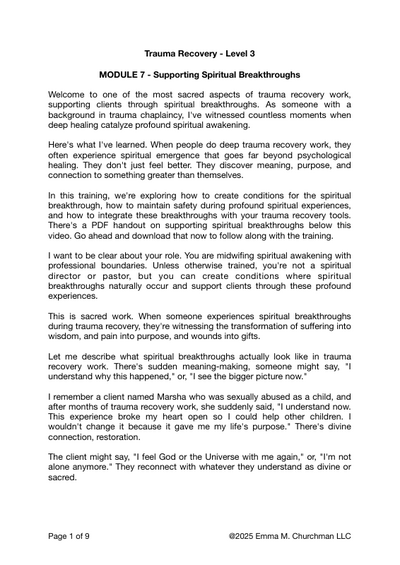
Trauma Recovery - Level 3
MODULE 7 - Supporting Spiritual Breakthroughs
Welcome to one of the most sacred aspects of trauma recovery work, supporting clients through spiritual breakthroughs. As someone with a background in trauma chaplaincy, I've witnessed countless moments when deep healing catalyzes profound spiritual awakening.
Here's what I've learned. When people do deep trauma recovery work, they often experience spiritual emergence that goes far beyond psychological healing. They don't just feel better. They discover meaning, purpose, and connection to something greater than themselves.
In this training, we're exploring how to create conditions for the spiritual breakthrough, how to maintain safety during profound spiritual experiences, and how to integrate these breakthroughs with your trauma recovery tools.
There's a PDF handout on supporting spiritual breakthroughs below this video. Go ahead and download that now to follow along with the training.
I want to be clear about your role. You are midwifing spiritual awakening with professional boundaries. Unless otherwise trained, you're not a spiritual director or pastor, but you can create conditions where spiritual breakthroughs naturally occur and support clients through these profound experiences.
This is sacred work. When someone experiences spiritual breakthroughs during trauma recovery, they're witnessing the transformation of suffering into wisdom, and pain into purpose, and wounds into gifts.
Let me describe what spiritual breakthroughs actually look like in trauma recovery work. There's sudden meaning-making, someone might say, "I understand why this happened," or, "I see the bigger picture now."
I remember a client named Marsha who was sexually abused as a child, and after months of trauma recovery work, she suddenly said, "I understand now. This experience broke my heart open so I could help other children. I wouldn't change it because it gave me my life's purpose." There's divine connection, restoration.
The client might say, "I feel God or the Universe with me again," or, "I'm not alone anymore." They reconnect with whatever they understand as divine or sacred.
Page 1 of 9 @2025 Emma M. Churchman LLC
There's also purpose-clarity emergence. They might say, "I know what I'm meant to do with this experience." Their trauma transforms from meaningless suffering into sacred calling.
And then finally there's forgiveness-spontaneity. They might say, "I suddenly feel compassion for those who hurt me." This is not forced forgiveness. It's natural love that emerges from complete healing.
Here's the process I've observed countless times. First, there's a descent into darkness where trauma creates spiritual crisis and disconnection where they lose faith, meaning, and connection to the sacred.
Second, there's wrestling with meaning. The question of "Why did this happen to me?" begins - they're angry at God. They're questioning everything they believed their feeling spiritually abandoned.
Third is their breakthrough moment. That sudden shift of "How FOR me" becomes their spiritual understanding. Something clicks and they see their experience from a completely different perspective.
And then fourth is the integration and service. They use their spiritual insights for healing and for helping others. Their breakthrough becomes the foundation for serving others who are still suffering.
I've witnessed four main types of spiritual breakthroughs. First is meaning-making breakthroughs where they find sacred purpose and suffering. They might say, "This happened so I could become a healer," or "My trauma prepared me to help others".
Second, there's connection breakthroughs where they've restored relationships with the divine or the sacred. They might say, "I feel God's love again," or "I'm connected to something bigger than myself."
Third is forgiveness breakthroughs where there's a spontaneous release of resentment and blame. They might say, "I suddenly feel love for my abuser," or, "I understand they were wounded too."
Fourth is service breakthroughs where they understand how their healing serves others. They might say, "My job is to transform this pain into healing for others," or "I'm meant to be a wounded healer."
There's also the neurological-spiritual connection, and here's something really fascinating. Spiritual breakthroughs often coincide with neural pathway integration. When the brain creates new pathways for processing trauma, it also creates space for spiritual awareness. Spiritual breakthroughs often coincide with neural pathway integration. The same neurological changes
Creating Conditions for Spiritual Breakthroughs
that heal trauma also often open spiritual awareness. The "how FOR me" shift creates space for spiritual emergence. When they stop being victims of their trauma, they can see it as serving their spiritual evolution. Regulated nervous system allows access to spiritual awareness because you cannot access spiritual states when you are dysregulated.
The trauma recovery tools prepare the ground for spiritual awakening. Trauma recovery tools help. They don't cause the breakthrough, but they create the conditions where it can naturally occur.
So let's talk about creating the right conditions for spiritual breakthroughs. The first is sacred space creation where you honor the spiritual dimension within your clinical setting. This doesn't mean religious symbols, it means creating an atmosphere of reverence and safety.
Second is energetic safety, where your regulated presence creates a container for spiritual emergence. When you're grounded and present, clients feel safe enough to open spiritually.
Third is timing awareness. Breakthroughs often occur during the reconstruction to evolution transition, so they've done enough healing work to be ready for spiritual emergence.
And then finally is when you offer openness without an agenda - where you create space without forcing spiritual experience. You cannot make a spiritual breakthrough happen, but you can create conditions where it's more likely to occur.
Trauma Recovery Tools for Spiritual Opening
Let's discuss your trauma recovery tools that can facilitate spiritual opening. First is the Morning Mental Weather Report where you ask, "How is your spiritual weather today?," Including the spiritual dimension in their daily check-in.
Second is the Energy Management Grid where you assess and replenish the spiritual quadrant when their spiritual energy is depleted - making breakthroughs less likely.
Third is the Intuitive Response Protocol where your spiritual sensitivity guides the session - where you can trust your intuition about when to go deeper and when to pull back.
And finally is the Adaptive Transformation Grid where you can track spiritual growth alongside other dimensions. Spiritual breakthroughs show up as growth in the spiritual dimension.
Page 3 of 9 @2025 Emma M. Churchman LLC
Let's talk about the role of suffering in spiritual breakthrough because this is crucial to understand. Suffering often precedes spiritual breakthrough. For example, honoring the darkness, not rushing clients to have a spiritual crisis. Sometimes they need to wrestle with God, question everything, and feel spiritually abandoned. That is part of the process.
Second is sacred witnessing, holding space for that spiritual questioning and anger. Letting them say, "I hate God for letting this happen," is often the beginning of a spiritual breakthrough, not the end.
Third is offering meaning-making support, saying, "How might this experience be serving your soul's evolution?" Asking the question gently without forcing an answer.
And then finally is divine wrestling. Supporting clients through spiritual struggle like Jacob wrestling the angel. Sometimes you have to fight with the divine to receive your blessing.
I remember a client who spent months angry at God. She would rage in sessions about how God had abandoned her. I just witnessed it and held space. And then one day she said, "I think God was with me the whole time. I think God was crying with me." That was her breakthrough.
Recognizing Pre-Breakthrough Indicators
So watch for these signs that a spiritual breakthrough is approaching. The first is spiritual hunger intensifies. There's increased seeking, questioning, and spiritual reading. They're desperately searching for spiritual connection.
Second is existential restlessness. They're asking, there has to be more to this or saying, "I'm searching for something I can't name." They sense that something bigger is coming.
Third is meaning-making attempts. They're trying to understand purpose in their suffering. They're actively wrestling with the why questions.
And then fourth is service orientation emerging. They're saying to themselves, "How can I help others who have been through this?" They're starting to see their experience as potentially valuable to others.
Maintaining Appropriate Presence
When a spiritual breakthrough happens, here's how to maintain appropriate presence. First, you want to witness without interpretation. Let them discover their own spiritual meaning. Don't tell them what their experience means, let them tell you.
Second
is stay grounded while they transcend. Your regulation anchors their experience. They need you to be the steady presence while they're having a transcendent experience.
Third
is professional boundaries. You facilitate, you don't provide spiritual guidance. You create the conditions. You don't direct the spiritual experience.
And then fourth
is sacred witnessing. You honor the profound nature of their spiritual experience. This is sacred territory and your reverence matters.
Here's some common spiritual breakthrough experiences I've witnessed.
- First is a divine encounter where someone says, "I felt God's presence," or "I experienced unconditional love." They have a direct experience of the divine, however they understand it.
- Second is a life review. They say, "I saw how everything connected," or "I understood my soul's journey." They see their entire life from a spiritual perspective.
- Third is a forgiveness download. They say, "I suddenly felt compassion for everyone involved." Forgiveness - Forgiveness happens spontaneously, not as an effort of will.
- And then finally is purpose revelation. They say, "I know why I'm here," or "I understand my mission now." Their life purpose becomes crystal clear.
I remember a client named David who was in a car accident that killed his daughter. After a lot of trauma work, he suddenly said, "I saw her. She told me she's okay, and that my job now is to help other parents who lost children. I understand why I survived." That was his spiritual breakthrough.
Here's how to respond professionally to a spiritual breakthrough.
- You can begin by normalizing the experience saying, "Spiritual breakthroughs are common in deep healing work. What you're experiencing is natural and meaningful."
- Second, you can validate without interrupting. You can say, "That sounds like a profound experience for you. How does it feel in your body right now?"
- Third, you can support integration. You might ask, "How does this spiritual insight affect your healing journey?" Or "What does this mean for your daily life?"
- And fourth, maintain your clinical focus. You can say, "How can we integrate this breakthrough within your trauma recovery tools? How does this change your Energy Management Grid?"
Page 5 of 9 @2025 Emma M. Churchman LLC
Support for Spiritual Breakthroughs
Sometimes spiritual breakthroughs can be overwhelming. So here's how to provide support if that happens.
- Grounding Techniques: Use the 5-4-3-2-1 Senses Inventory to maintain present moment awareness. For example, you can say, "Let's ground you in your body. Tell me five things you can see right now."
- Regulation Support: Offer regulation support using the 90-Second Reset. If spiritual experiences create activation, sometimes a spiritual breakthrough can be activating rather than calming.
- Reality Anchoring: Help them stay connected to their body and their current environment. You could say, "Feel your feet on the floor," or "You're safe here with me."
- Professional Boundaries: Refer to a spiritual director if ongoing spiritual guidance is needed. You might say, "This spiritual opening might benefit from ongoing spiritual direction. Would you like some help finding someone?"
I once had a client who had such a profound spiritual breakthrough that she wanted to quit her job and become a nun immediately. I helped her ground the experience and then referred to help her explore that calling more gradually with someone who was Catholic.
The spiritual breakthrough needs to be integrated into daily life using your trauma recovery tools. For example, you can utilize the Morning Mental Weather Report to include spiritual weather and insight. You can ask, "How is your spiritual connection today? What spiritual guidance are you receiving with the Energy Management Grid?"
The spiritual quadrant is now informed by the breakthrough experience there. Spiritual energy will likely be much higher and more stable with the Three-Column Decision Matrix. Decision-making can now include spiritual wisdom. They can ask themselves, "What does my spiritual guidance say about this decision?"
And then finally, with neural pathway integration, new spiritual understanding creates new response patterns. Their spiritual breakthrough has likely rewired their brain.
Here's how to support integration:
- Gradual Integration: Do not expect immediate life changes from a spiritual breakthrough. Integration takes time. They don't need to change their entire life overnight.
Page 6 of 9 @2025 Emma M. Churchman LLC
Second is practical application. You can ask, "How does this spiritual insight guide your daily choices? What would change in your relationships, your work, or your daily routines?"
Third is community support, encouraging connection with their spiritual, excuse me, with their spiritual community for ongoing support. They need people who understand and support their spiritual growth. And then finally continued trauma work. Spiritual breakthroughs don't end the need for trauma recovery tools. They still need to maintain their nervous system regulation and continue their healing work.
Common Integration Challenges
Let's talk about these common integration challenges. First is spiritual bypassing where they use spiritual insights to avoid emotional processing. They might say, "I've forgiven everyone so I don't need to feel my anger". That is bypassing, not integration.
Second is overwhelm. Spiritual breakthroughs may create too much change too quickly, where they want to transform their entire life immediately.
Third is isolation. They may feel like others won't understand their spiritual experience. They may feel alone in their spiritual awakening.
And then fourth is identity confusion. They might say, "If I'm spiritually awakened, why do I still need trauma work?" They think their spiritual breakthrough means that they're done with the healing.
Advanced Techniques for Integration
Here are some advanced techniques for integration. First is spiritual meaning-making, helping them articulate how trauma serves their spiritual evolution. You might ask, "How has your trauma experience contributed to your spiritual growth?"
Second is service orientation where you support their desire to help others through similar experiences. You might ask, "How do you want to use your healing and spiritual insights to serve others?"
Third is wisdom extraction. You might ask, "What spiritual truths did you discover through this experience?" Or "How do you want to live these truths?"
And then finally, there's sacred story creation where you can help them reframe their trauma story as a spiritual journey. Their story then becomes a teaching tale rather than just a trauma narrative.
Of course you want to maintain clear professional boundaries around spiritual work because you're facilitating the spiritual breakthrough. You're not providing spiritual direction unless you're already a spiritual director.
create conditions. You don't guide their spiritual practice. You support their integration. You don't interpret their spiritual experiences. You help them make sense of their experience, but you don't tell them what it means. You witness their spiritual emergence. You don't guide spiritual practice. In other words, you honor their experience, but you don't teach them how to pray or meditate.
And then you refer to spiritual professionals for ongoing spiritual guidance. So really identifying when they need a spiritual director or pastor or minister or spiritual mentor. You want to refer to spiritual professionals when - One, the client wants ongoing spiritual direction or guidance, and they need someone to help them develop their spiritual practice and understanding spiritual breakthroughs creates the need for a religious or spiritual community. They're going to need connection with others who share their spiritual path.
Second complex spiritual experiences require specialized spiritual support. Some spiritual experiences need interpretation from someone trained in spiritual direction.
And then third, a client's spiritual needs exceed the trauma recovery scope. When their spiritual needs become the primary focus, they need specialized spiritual support and it's time to refer out.
In closing, here's what I want you to remember. Spiritual breakthrough is often the culmination of deep trauma recovery work. When someone has done the hard work of healing their nervous system, processing their trauma and reconstructing their life, spiritual emergence often naturally follows your professional.
Witnessing of spiritual emergence is sacred service. You're not just facilitating psychological healing, you're midwifing spiritual awakening. Integration of spiritual breakthrough with trauma recovery tools creates lasting transformation. The combination of spiritual insight and practical tools creates sustainable change that serves both the individual and the world.
Your assignment for this module is to practice recognizing and supporting spiritual dimensions in healing conversations with friends, family members, or colleagues who have overcome significant challenges.
The setup is that you want to find someone who has been through a difficult experience and emerged with greater wisdom, purpose, or spiritual awareness. This could be someone who overcame illness, loss, addiction, relationship challenges, or other life difficulties.
So part one is you want to listen for their spiritual language patterns, their meaning-making statements, their purpose, clarity, their connection,
Restoration and Service Orientation
You want to ask gentle spiritual exploration questions like, "How has this experience affected your sense of purpose?", or "What meaning have you found in going through this?" Or "How do you understand this experience in the bigger picture of your life?" Or "What spiritual insights or growth have you noticed?"
You want to practice witnessing without interpreting. So listen without often offering your own spiritual interpretations, reflect back what you hear without adding your own beliefs. And ask questions that help them explore their own spiritual understanding.
And while you're doing that, practice appropriate boundaries. Support their exploration without directing it. Validate their experience without interpreting it, and recognize when they might benefit from a referral.
And then help them connect insights to their daily life. What practical changes have they made based on the understanding, or how do they maintain connection to this wisdom and everyday life and support their service orientation about how they feel called?
The reflection questions that you'll address in this module are, "What spiritual language patterns did you notice in their story?" "How comfortable were you discussing spiritual dimensions of healing?" "What was challenging about witnessing without interpreting their experience?" "How did you maintain appropriate boundaries while supporting their spiritual exploration?" "What did you learn about the connection between trauma recovery and spiritual growth?" And "How might this practice help you recognize the spiritual dimensions in your own trauma recovery work?" The assignment is posted at the end of this module.
Page 9 of 9 @2025 Emma M. Churchman LLC