Disaster response and recovery organizations

/
Customized Trauma Recovery Trainings
When Crisis Strikes, the People Helping Others Are Carrying It Too
Customized trauma recovery trainings for disaster response teams and corporate operations workforces - designed for the people who show up when everything falls apart, and the organizations that depend on them to keep functioning.
Frontline workers. First responders. Disaster relief and recovery staff and volunteers. Community care workers. Field operations crews. Customer-facing teams in the middle of a company-wide crisis. You run toward the disruption. You hold space for survivors, customers, and colleagues. You make decisions under pressure that most people never face.
And then you go home and try to function.
The Chrysalis Alliance offers on-site and virtual trauma recovery trainings built for two kinds of organizations: those on the front lines of disaster response, and those managing operations workforces through incident, disruption, and sustained crisis.
Practical, accessible, and grounded in real field experience.
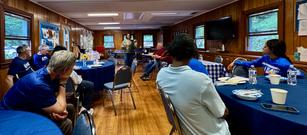
Who We Train
Disaster Response & Community Organizations:
Long-term recovery groups (LTRGs)
Faith-based and volunteer response networks
Community care and relief organizations
Chaplaincy and spiritual care teams
Nonprofit organizations serving traumatized communities
Corporate & Operations Workforces:
Field and operations staff in high-exposure or hazard-adjacent environments
Emergency and incident response teams managing active crisis events
Customer service and community relations representatives in contact center and public-facing roles
Safety, health, and wellbeing professionals responsible for workforce resilience programs
Supervisors and team leads who manage staff through disruption and recovery cycles
L&D and HR professionals designing or scaling trauma-informed workforce programs
Industries served: Utilities, energy companies, healthcare systems, manufacturing organizations, financial services firms, insurance companies, airlines, government agencies.
Disaster Response: The Problem
Compassion Fatigue Isn’t a Weakness. It’s What Happens When There’s No Off Switch.
Disaster response workers face compound trauma - the event itself, the ongoing suffering of those they serve, the chaos of operations, and the emotional labor of holding everyone else together.
Without real tools and real processing, that accumulates into:
- Burnout and staff/volunteer turnover
- Secondary traumatic stress and PTSD symptoms
- Deteriorating team communication under pressure
- Decision and compassion fatigue that slows response effectiveness
- Long-term organizational instability long after the disaster has faded from the news cycle
A four-hour training won’t fix everything. But it gives your team a common language, immediate tools, and a path forward - and that changes everything.
Corporate Operations & Field Teams: The Problem
This is an operational risk problem.
Trauma in the operations workforce is not a personal wellness issue. It is a business continuity problem, and the data is unambiguous.
30 to 50 percent of frontline and operations staff in high-exposure roles exhibit measurable symptoms of secondary traumatic stress within 12 to 18 months of sustained crisis work.
Voluntary turnover in operations and field service roles costs between $15,000 and $45,000 per employee when recruiting, onboarding, and ramp-up costs are fully accounted for.
For a 500-person operations workforce with a conservative 15 percent annual trauma-related attrition rate, preventable turnover costs exceed $1.1 million per year — before accounting for the institutional knowledge walking out with them.
Productivity losses of 15 to 30 percent are consistently reported during and after major crisis events.
Secondary traumatic stress is directly linked to increased safety incidents. Dysregulated employees make faster, less accurate decisions.
Untrained staff do not bounce back on their own. They become avoidant, inconsistent, and eventually absent. Their managers, who have not been equipped to recognize dysregulation or respond to it effectively, cannot intervene. The pattern compounds.
TCA training gives operations teams a practical, repeatable system for processing stress in real time.
Choose the Format That Fits Your Organization and Timeline
The Chrysalis Alliance works around your schedule, your setting, and your team’s capacity.
All formats available on-site or virtually.
Trauma Recovery Skills Lab (4 Hours)
A focused half-day intensive built for maximum impact with minimum logistics. This is not an overview - participants leave with tools they can use the same afternoon.
The Skills Lab is designed for teams that cannot commit to multi-day programming. It fits into shift schedules, pre-deployment or post-deployment windows, and high-demand periods when available time is compressed. For organizations navigating a surge or an active incident cycle, it provides meaningful support without pulling staff out of rotation for extended periods.
Best for: onboarding, annual refreshers, pre-deployment briefings, post-incident recovery, and surge-period training.
Serves both disaster response organizations and corporate operations workforces.
Train the Trainer Program (3 Days)
For organizations that need sustainable internal training capacity without ongoing vendor dependency.Day 1 and Day 2: participants complete the full Trauma Recovery Certification Program. Day 3: facilitation training, scenario libraries built specifically for the organization’s operational environment, coaching scripts, and a licensed curriculum package.
Organizations leave with trained internal trainers who can deliver trauma recovery skills to their own teams - on their schedule, in their language, without coordinating external resources every time a new cohort needs training.
Best for: organizations with distributed teams, regional structures, or high-volume training needs. This format is particularly well suited to utilities, healthcare systems, and large disaster response networks where consistent capability across sites is a core operational requirement.
Serves both disaster response organizations and corporate operations workforces.
Custom Training Program
(Scope Varies)
Not every organization’s trauma exposure pattern looks the same. A utility responding to a grid-down event has different operational rhythms than a long-term recovery group supporting a flood-affected community. A contact center absorbing displaced customer calls after a regional disaster has different role demands than a field crew doing physical recovery work.
Custom programs are purpose-built around the organization’s specific workflows, roles, and trauma exposure patterns. TCA maps training design to incident types, team structure, operational calendar, and regulatory environment. The result is not a rebrand of the standard curriculum - it is a training experience built from the ground up for the people in the room.
Integration with existing safety protocols, onboarding systems, employee assistance programs, or compliance frameworks is available. For corporate clients, TCA can work directly with HR, L&D, and EHS teams to design programs that align with existing workforce development infrastructure.
Serves both disaster response organizations and corporate operations workforces.
Trauma Chaplain Support
(Embedded or On Call)
Dedicated trauma chaplain support for frontline workers: crisis response, grief processing, and spiritual care delivered without religious proselytizing or denominational assumptions. This is not pastoral counseling - it is specialized support for people navigating loss, shock, moral injury, and the sustained weight of bearing witness to others’ suffering.
Embedded: Scheduled presence within teams on an ongoing basis, providing consistent access to support as part of the operational rhythm rather than as a crisis intervention.
On Call: Deployed following high-impact events - a major incident, a workforce fatality, a community-scale disaster affecting the operational area. On-call support is designed to arrive quickly, integrate without disruption, and provide structured processing for teams that have experienced something significant.
For corporate clients, on-call chaplain support is a particularly effective complement to existing EAP offerings, providing direct human presence that employee assistance phone lines cannot replicate.
Serves both disaster response organizations and corporate operations workforces.
What Teams Learn
TCA training builds workforce-visible capabilities -skills that change how staff behave during and after high-stress events, not just how they feel about them afterward.
Acute stress
regulation
Staff learn specific techniques for managing nervous system activation in real time - during a live customer interaction, an active deployment, or an incident that is still unfolding. Applied in the moment, where the moment demands them.
BETWEEN-INTERACTION RESET ROUTINES
That prevent stress accumulation across a full shift or deployment. The goal is not to recover at the end of the day - it is to prevent the buildup that makes the end of the day feel impossible.
a decision map,
not a menu
Quick regulation tools are structured into a readiness and sequencing framework. Staff assess their own functional state and select the appropriate tool for that state. Supervisors learn to recognize dysregulation in their teams and respond effectively - before it becomes an absence, an incident, or a resignation.
ETHICAL SCOPE-OF-ROLE BOUNDARIES
Staff understand the limits of their role clearly and have language for operating within those limits while remaining compassionate and effective. This prevents both over-involvement and the emotional shutdown that follows.
discreet in-the-moment regulation tools
Designed for front-facing and field environments where stopping work visibly is not an option. Built for the operational realities of shift work, public-facing roles, and high-tempo deployment environments.
REDUCED BURNOUT RISK
Through micro-practices for nervous system recovery and sustainable energy management - repeatable daily practices with measurable effects on energy levels and emotional availability over time.
BOUNDARY LANGUAGE FOR
HIGH-EMOTION SITUATIONS
Specific words and phrases for de-escalating without dismissing - language that works across the range of situations where someone is in distress and the staff member’s role does not extend to clinical intervention.
REFERRAL & ESCALATION DECISION POINTS
WITH CONSISTENT SCRIPTS
When someone needs more support than the role allows, staff know what to say, who to involve, and how to make that transition without leaving the person feeling dismissed.
Led by People Who Have Worked in Crisis - Not Just the Classroom
The Chrysalis Alliance is currently training staff and volunteers across more than 25 disaster response and recovery organizations. Organizations currently utilizing TCA training include the Salvation Army, United Way, UMCOR (United Methodist Committee on Relief), Mennonite Disaster Service, California 211, American Baptist Home Mission Societies, Team Palisades, CORE (Community Organized Relief Effort), United Policyholders, and Lutheran Disaster Response.
TCA’s four-phase trauma recovery model aligns with FEMA and NVOAD frameworks, making it a natural fit for organizations already operating within those structures. All training formats are available on-site and virtually, with no geographic restriction on delivery.
“We don’t just teach trauma recovery. We’ve lived it, processed it, and built a system that works when everything else is falling apart.”
Your Team Gives Everything to Customers and Survivors.
Give Them This.
For Disaster Response Organizations
Your teams are doing essential work in conditions that take a real toll.
We can help.
For Corporate & Operations Workforces
If you are responsible for a workforce that has been through a significant disruption - or that routinely operates in high-exposure conditions - we can help you quantify the risk, design a program that fits your operational structure, and build lasting internal capacity.
✓501(c)3 registered nonprofit | EIN: 42-1834781
✓Founded by Emma M. Churchman LLC | Gerton, NC
✓Aligned with FEMA national disaster management standards
✓ Aligned with NVOAD emotional and spiritual care guidelines
___MESSAGE___
___MESSAGE___